Roofing guide
How to find where a flat roof is really leaking
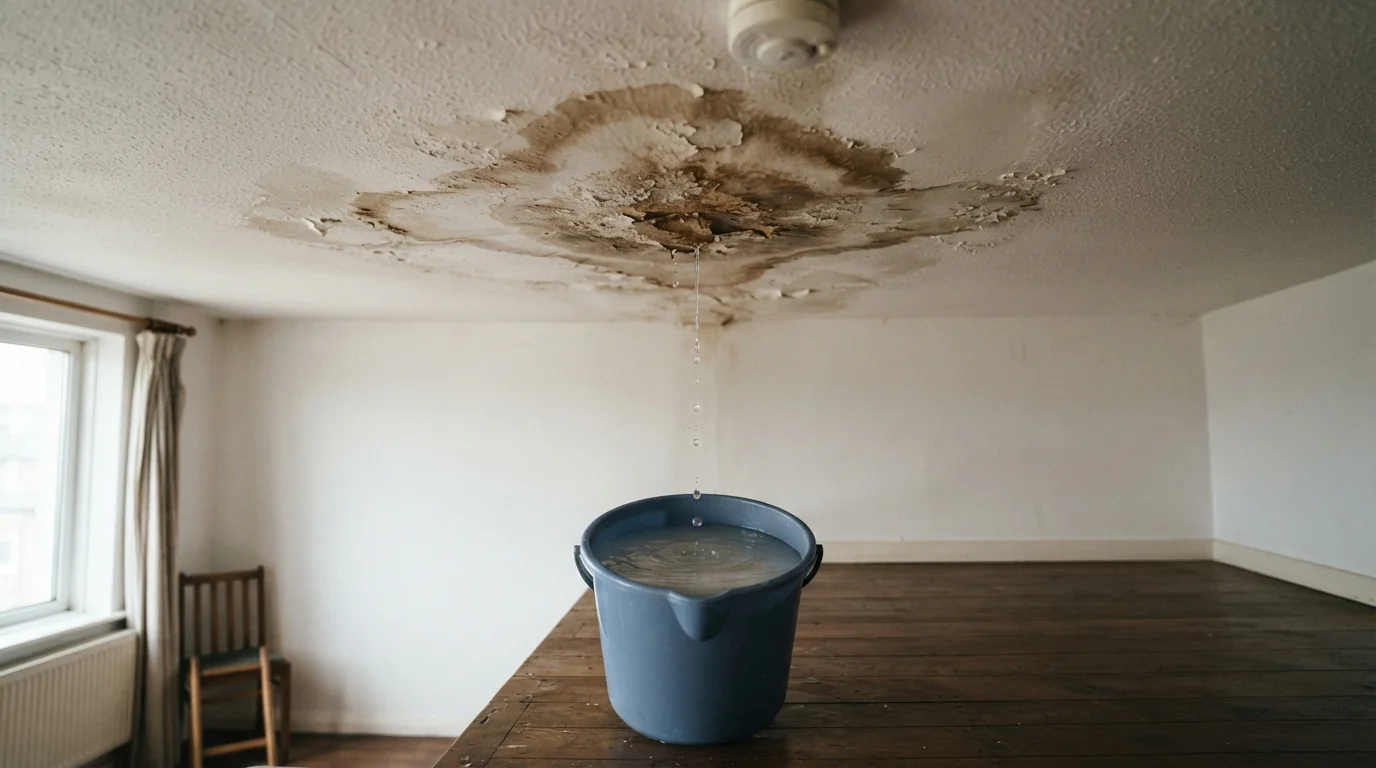
The stain on the ceiling is where the water stopped, not where it started. Here is how the path gets traced back to the real entry point.
By Ada Lombardi, Roofing Guides EditorPublished 3 min read
Key takeaways
- Most flat roof leaks enter at flashing, seams, drains or parapets, not in the open field of the roof.
- Water can travel several feet under the membrane or through insulation before it shows inside.
- Tracing runs in order: the pattern inside, a walk of the likely path, moisture readings, then water testing.
- Roof cement and ceiling sealers hide the entry point and make the real repair harder.
Why the stain is in the wrong place
A flat roof is a stack of layers: the membrane on top, often a cover board and rigid insulation beneath it, then the deck. When water gets through the membrane, it does not fall straight down. It runs along the top of the insulation, soaks into it, or follows the deck until it finds a seam in the ceiling below.
Newer roofs make this worse, not better. New York's energy code calls for R-30 of insulation above the deck on low-slope roofs insulated that way, so a recently replaced roof can carry several inches of foam board that spreads water sideways before any of it reaches a ceiling.
Where water usually gets in
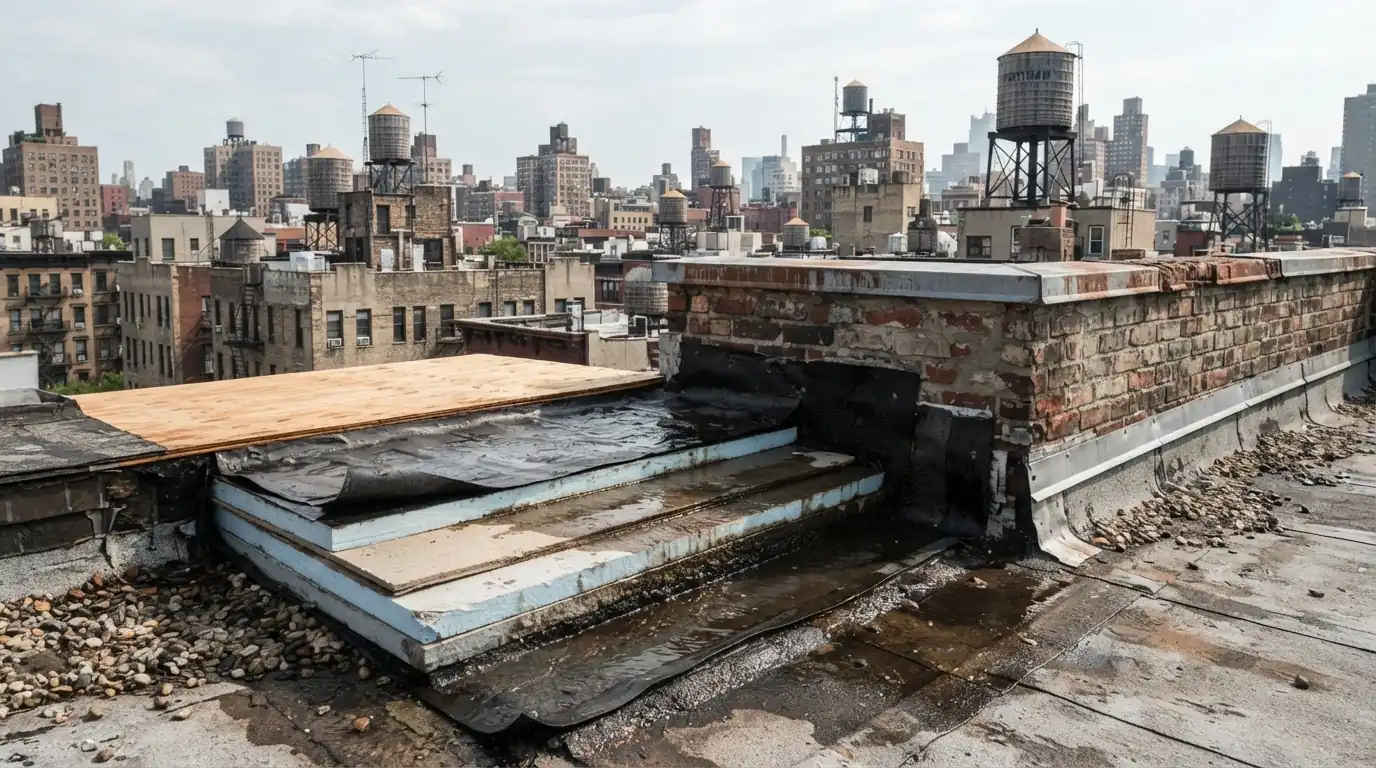
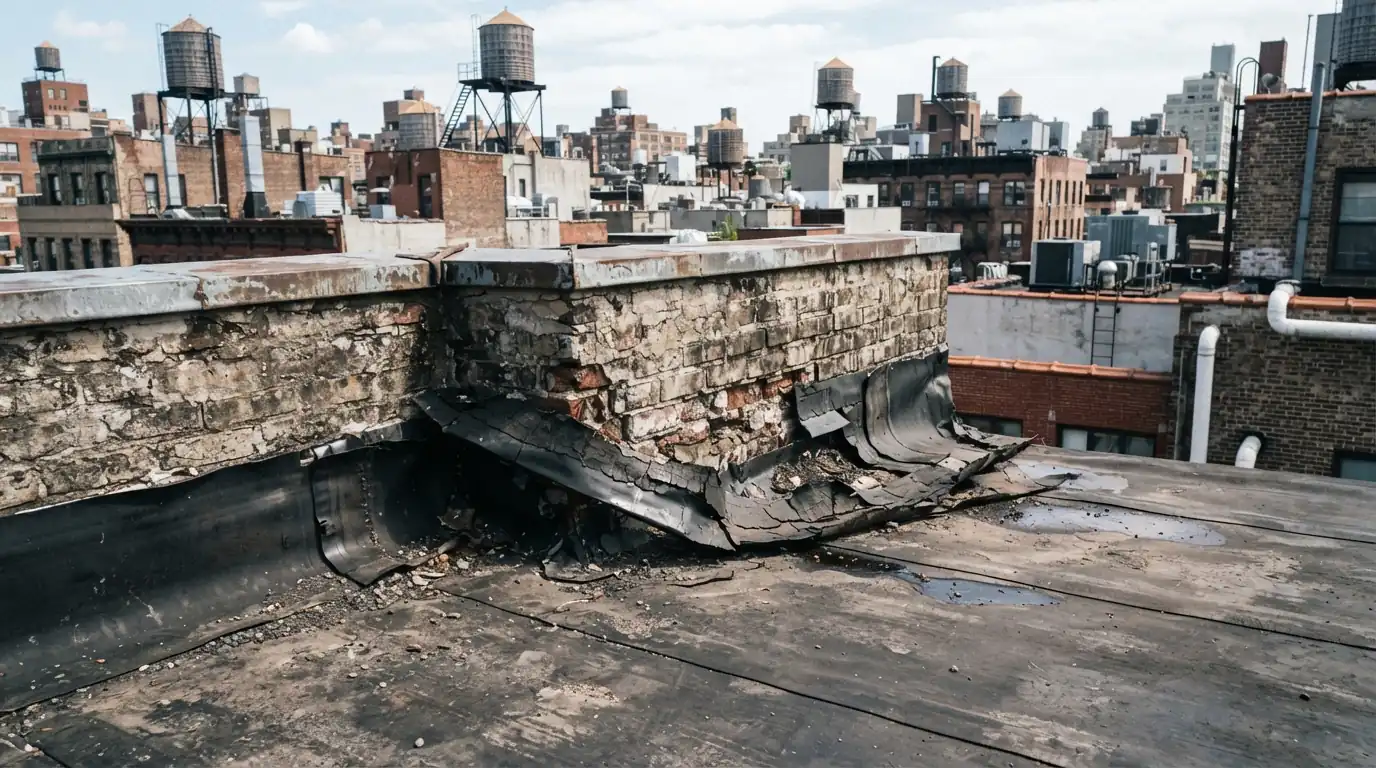
On city flat roofs the usual entry points are the edges and interruptions, not the middle. Base flashing where the membrane turns up a parapet shrinks and peels. Counter flashing above it pulls out of its joint. Older EPDM seams let go as their adhesive ages. Drains leak where the membrane is clamped to the drain bowl, and pipe boots and pitch pockets crack and shrink.
Two sources are easy to miss because they are not the roof at all. Parapet walls and their coping let water into the masonry, where it runs down inside the wall. And stair bulkhead door sills often sit level with the roof, so water crossing the roof runs straight under the door.
Reading the clues inside
When the leak happens tells you as much as where. A leak in every rain points to an open seam or failed flashing. A leak only in very heavy rain suggests water rising above flashing height because a drain cannot keep up. A leak only in wind-driven rain usually means a parapet, coping or counter flashing on one side of the building.
Location narrows it further. Stains along an exterior wall point to the parapet and its flashing. Drips around a skylight well point to the curb. A stain in the middle of a room under a spot where water ponds points to a pinhole or seam under standing water. A leak that starts right after equipment service often means a puncture.
How roofers trace it on the roof
The roof walk starts at the stain and works uphill: every seam, flashing, drain and penetration between the stain and the high side of the roof. Obvious failures are photographed and tested first.
When nothing is obvious, moisture readings on a grid show where the insulation is wet, and small core cuts confirm what the readings suggest. Then comes water testing, one section at a time, starting low and moving up, with someone watching inside. When the drip appears, you know which section let it in. If the roof tests dry, the walls get tested next.

What not to do
Do not hose the whole roof from the top down to find the leak. Every seam floods at once and you learn nothing. Do not smear roof cement on a rubber roof; asphalt-based products are not compatible with EPDM and bond poorly to TPO. Do not seal the ceiling or the underside of the deck, which traps water in the roof and hides it.
And do not walk a wet, icy or dark roof to look. Photograph the stain, catch the water, note the weather, and let the tracing happen when the roof is safe.
Sources
Rules and figures in this guide come from these published sources. Check them for changes before relying on a rule for your building.
Get it done
Services related to this guide
Roof Leak Repair
Ceiling stains rarely sit under the hole. We trace the water back to the seam, flashing or drain that is letting it in, then fix that.
Learn moreRoof Leak Detection
For the leak three roofers have already patched. Moisture surveys, core cuts and water tests show where the roof is wet and why.
Learn moreRoof Flashing Repair
Base flashing, counter flashing and pitch pockets fail long before the open field of the roof does. Often the most cost-effective fix on a building.
Learn moreLeak you cannot find?
Call any time. We trace the water to where it gets in, then repair that.