Modified Bitumen Roofing
Cold-applied and self-adhered multi-ply systems for rowhouse roofs and roofs that take foot traffic, with a tough granulated cap sheet.
Learn moreA white single-ply membrane with seams fused by hot air rather than glued. We install TPO on flat roofs across the city and repair the TPO roofs already up there.
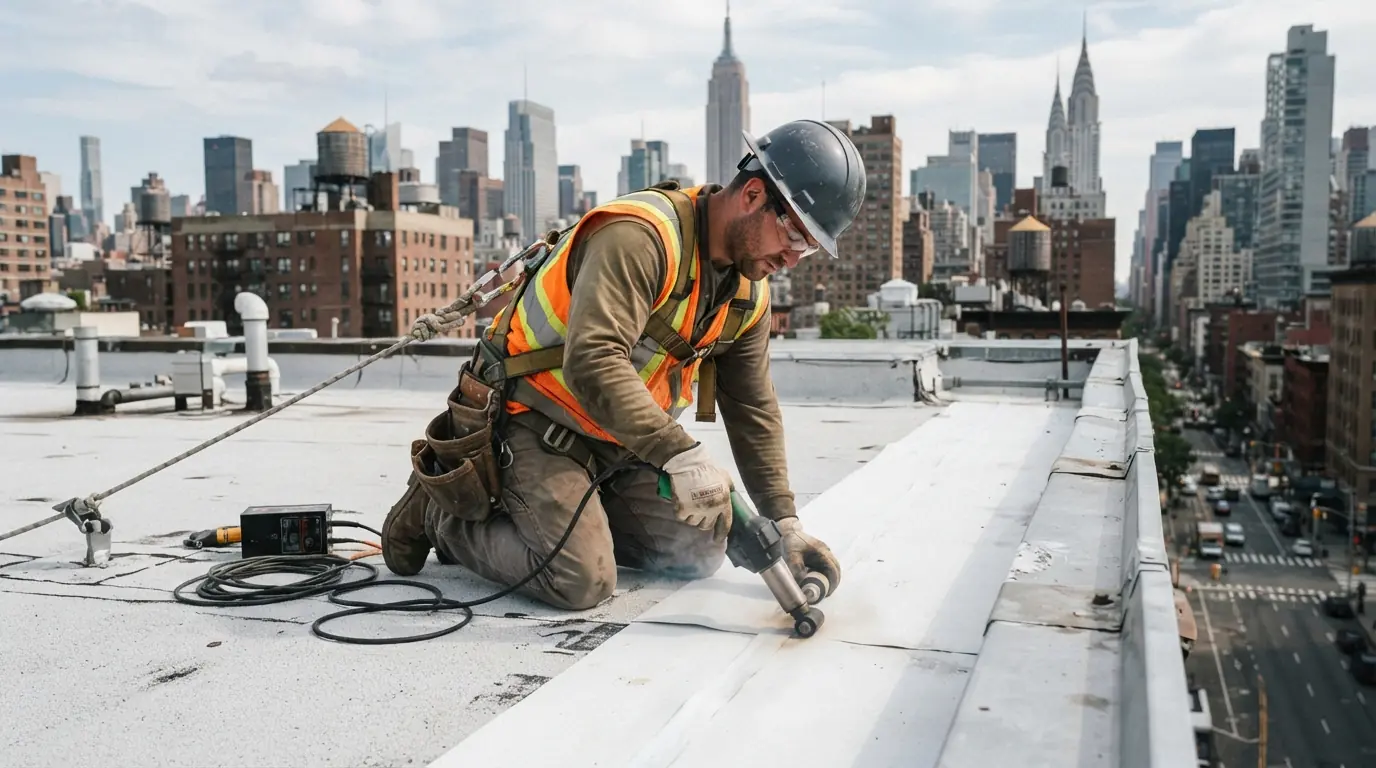
Quick answer: TPO is a white single-ply membrane whose seams are heat-welded into one continuous sheet. On flat roofs in New York, NY it suits larger roofs and roofs with equipment, meets the city's reflectivity requirement without a coating, and is repaired by welding a new piece onto the old one.
What the job involves
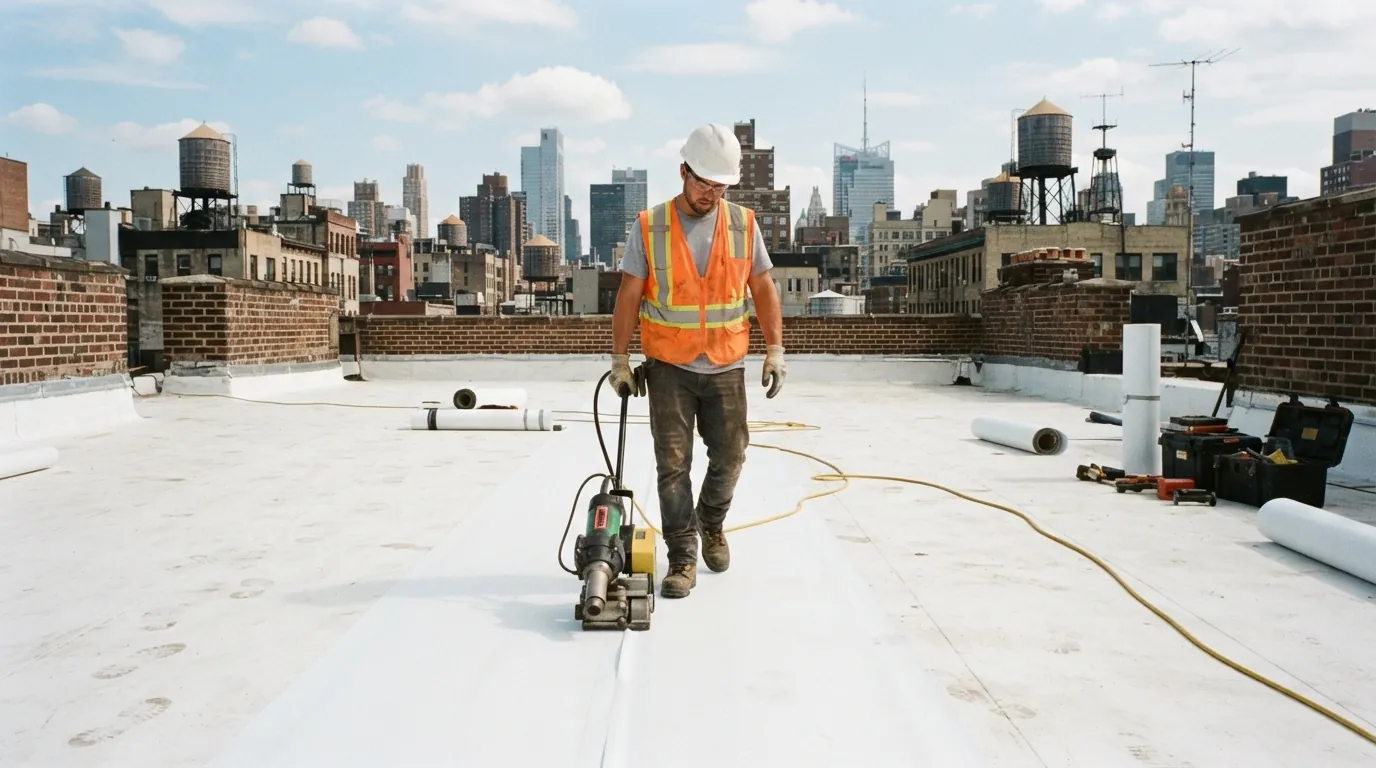
TPO sheets are joined with a hot-air welder that melts the edges together, so a finished seam becomes part of the sheet rather than a glued joint. That matters on large roofs with many seams, and on roofs where people walk to service equipment.
Because it comes white from the factory, TPO reflects summer sun without a separate coating. The tradeoff is care during installation: every weld is probed along its length, and the membrane needs protection where foot traffic is heavy.
Your options
| Option | Seams | Keep in mind |
|---|---|---|
| TPO | Heat-welded | White from the factory. Weld quality is everything. |
| White EPDM | Taped | Few seams on small roofs, but costs more than black EPDM. |
| Modified bitumen, reflective cap | Lapped and adhered | Tough under foot traffic. Reflectivity depends on the cap sheet or coating. |
Cost factors
Thicker sheets cost more and stand up better to traffic.
Fully adhered or mechanically attached, depending on roof size and deck.
Energy code thickness above the deck is a large part of the material.
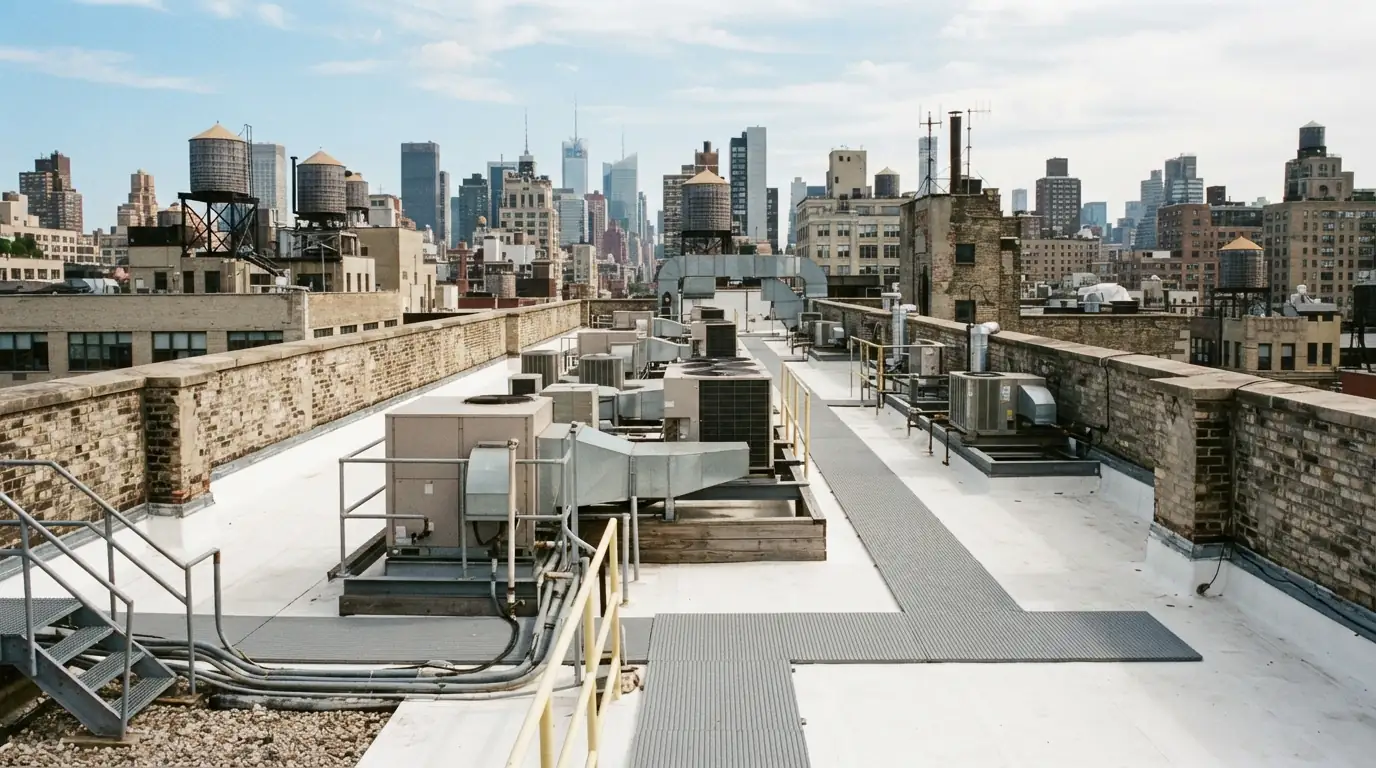
Each unit, curb and pipe needs its own welded flashing.
Removing old layers, sometimes several, adds labor and disposal.
Protecting service paths to equipment.
Typical range: Published 2026 figures put TPO in New York City at about $8.00 to $13.00 per sq ft installed. A planning figure, not a quote.
Variations of the job
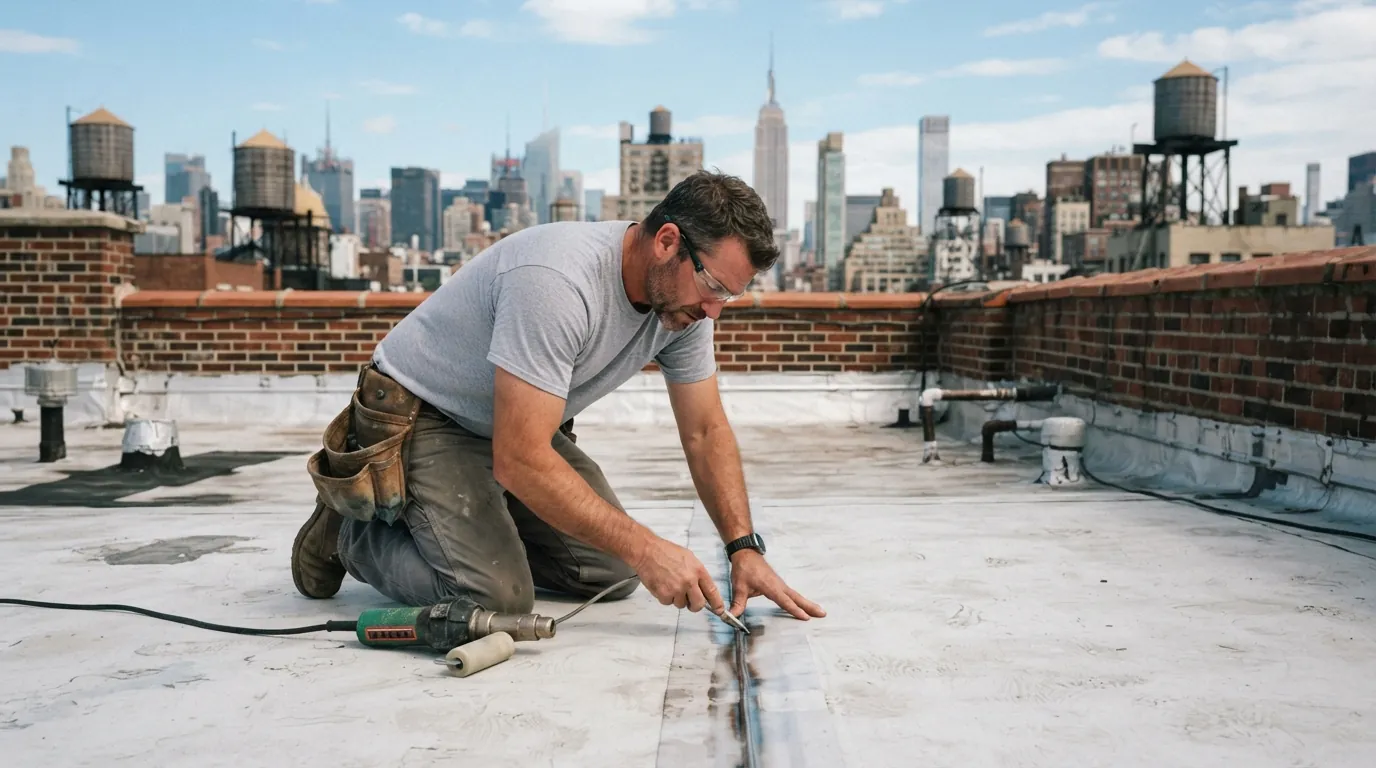
Every seam is welded with an automatic or hand welder, then probed along its length to catch cold spots. Open seams on existing TPO roofs are cleaned and rewelded.
The white surface keeps the roof and the top floor cooler in summer and meets the city's reflectivity rules. Keeping it clean of grime and soot keeps it reflective.
On larger roofs the membrane can be fastened through the insulation into the deck, with the fasteners hidden in the seam laps. Rowhouse roofs are more often fully adhered.
Local conditions
New York City requires roofs to meet solar reflectivity standards, with some exceptions, and white TPO meets them without a separate coating. On a black roof the alternative is a white cap sheet or a reflective coating that has to be renewed over time. For owners of larger buildings with equipment on the roof, that built-in reflectivity is often what tips the choice toward TPO.
How it runs
Tear-off or recover board, and deck repairs where needed.
Fastened down, with tapered sections where the roof needs slope.
Adhered or fastened, depending on the roof.
Hot-air welds checked along their full length.
Welded flashings at curbs and walls, walkway pads, final walk-through.
TPO makers you will find on New York roofs. Repairs are welded with membrane compatible with what is already there.
Questions we hear
Neither is better everywhere. TPO suits larger roofs and roofs with equipment, and it is white out of the box. EPDM suits small, simple roofs with few seams. The building decides.
Yes, though older TPO may need cleaning and conditioning before a new piece will weld to it. The repair is a welded patch, not a glued one.
A reflective roof absorbs less heat than a dark one, which keeps the roof surface and the floor below cooler in summer. In New York City it is also required on most roofs.
Yes, with care. Where there is regular foot traffic to equipment or a hatch, walkway pads are welded on to protect the membrane.
Over one dry, sound layer with a recover board, yes. Wet or multi-layer roofs need a tear-off first.
Related services
Cold-applied and self-adhered multi-ply systems for rowhouse roofs and roofs that take foot traffic, with a tough granulated cap sheet.
Learn moreSilicone and acrylic coatings that extend the life of a sound flat roof and make it reflective, applied only after seams and flashings are fixed.
Learn moreFluid-applied membranes for crowded roofs where sheet goods cannot reach: around dunnage, pipe clusters, railings and odd penetrations.
Learn moreCall for a roof survey and a TPO quote built around your building.
New York service office
1256 5th Ave, New York, NY 10029