Parapet Wall Repair
Street-facing parapets on row houses take weather from both sides and fall under the city's yearly observation rule.
Learn moreBrownstones, row houses and walk-ups under flat roofs, many of them inside landmark districts. We answer around the clock and fix the roof where the water is actually getting in.
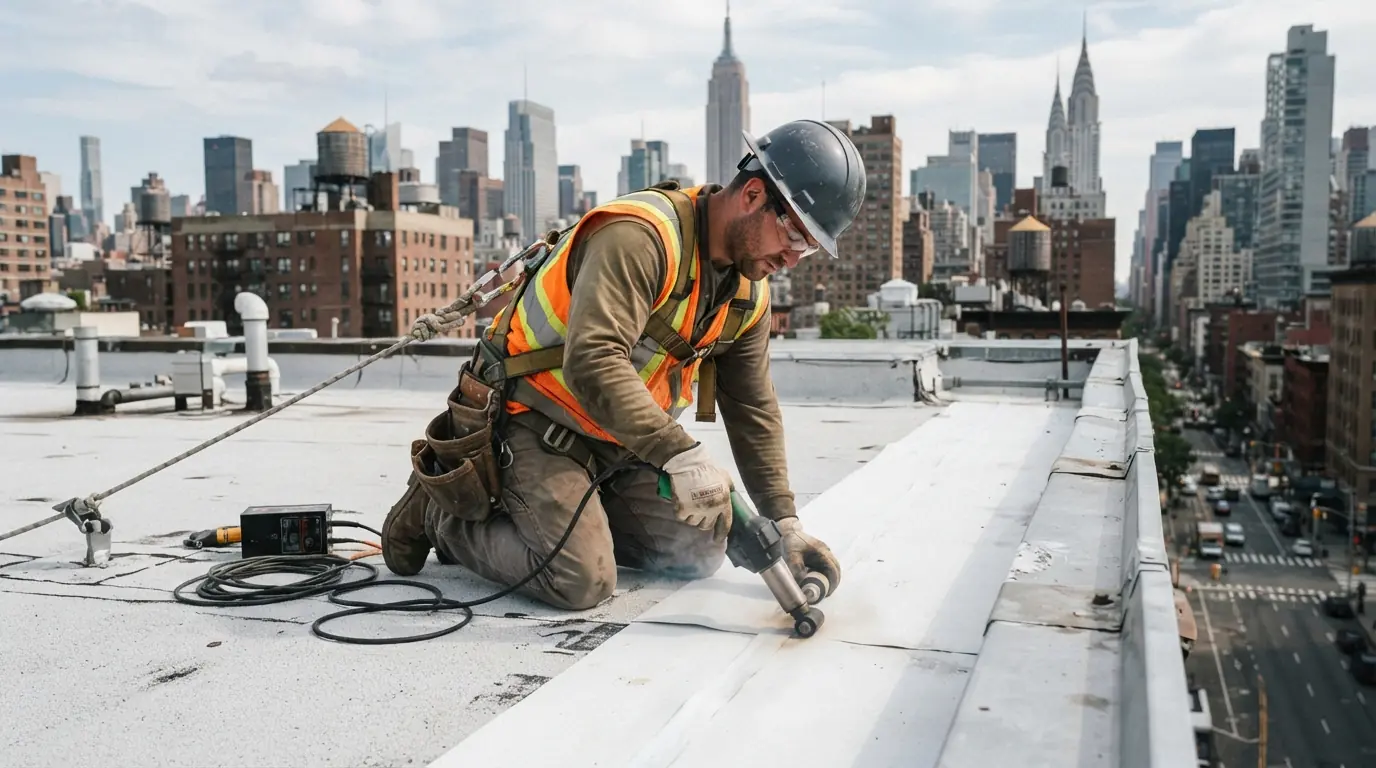
Quick answer: Most Brooklyn roof calls are flat-roof problems at the edges: open parapet joints, failed base flashing, blocked drains and tired skylight curbs on row houses and walk-ups. In a historic district, work that changes what is visible also needs a Landmarks Preservation Commission permit before it starts.
Roofs in Brooklyn
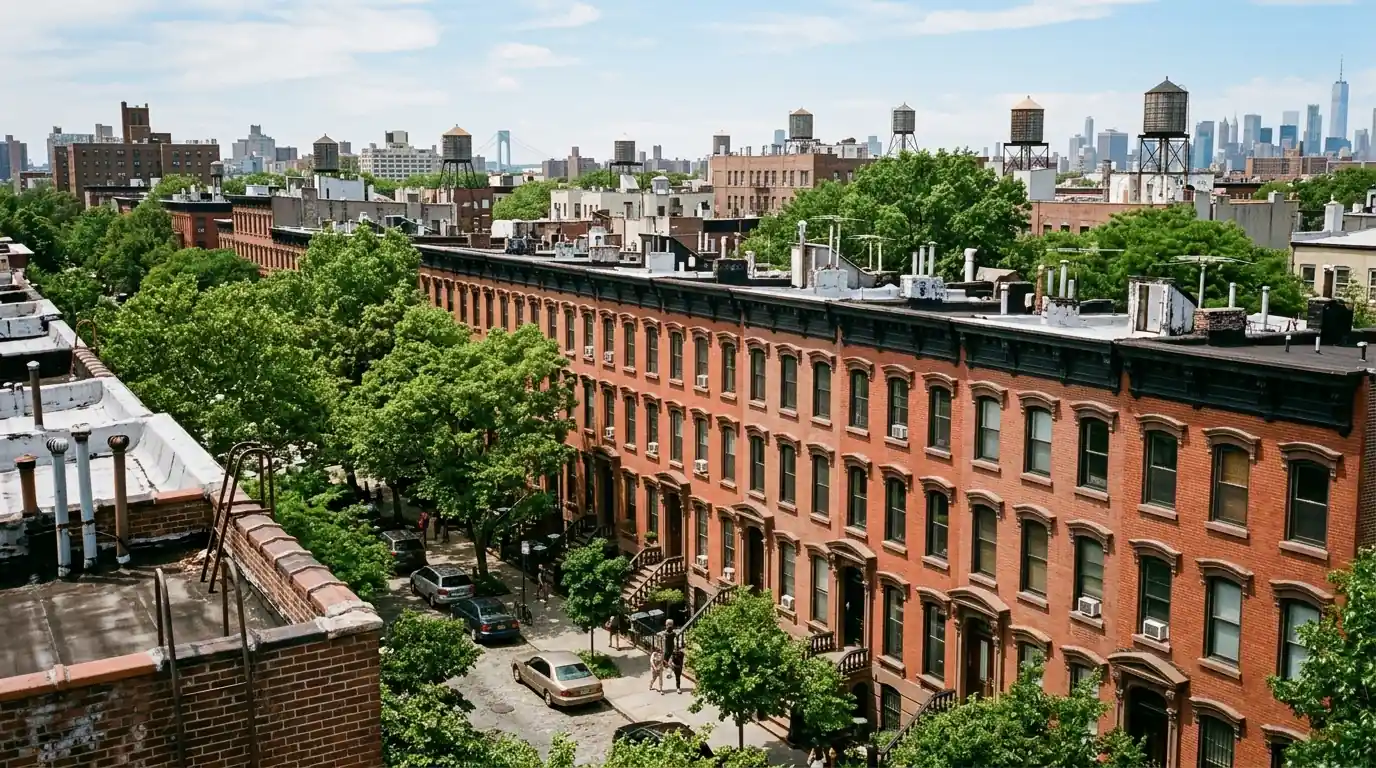
Brooklyn is a borough of row houses, and Park Slope shows the scale. Its historic district was designated in 1973 with 1,948 buildings, extended in 2012 by 613 more and again in 2016 by 292, and the city describes that last extension as mainly single-family row houses and flats built between the mid-19th and early 20th century.
Nearly all of them sit under low-slope roofs behind a brick parapet, with a bulkhead or hatch for access and a skylight over the stair. Those are the places water gets in: where the membrane turns up the parapet, the seams around the bulkhead, the curb under the skylight, and the drain that holds water once it clogs.
Brooklyn also took a large share of Hurricane Sandy's damage in 2012. The state's recovery reporting lists Kings County among the four counties where most of New York's storm damage to housing occurred.
Most-called jobs
Every roofing service is listed on our services page.
Street-facing parapets on row houses take weather from both sides and fall under the city's yearly observation rule.
Learn moreWhen the membrane is finished, a new one goes on with the insulation and slope the city's energy code asks for.
Learn moreBase and counter flashing at the parapet is where most row-house leaks start.
Learn moreStair skylights on old curbs leak at the curb long before the glass fails.
Learn moreOne clogged drain on a roof shared by a row of houses can put water against everyone's parapet.
Learn morePressed-metal cornices rust at their seams and let water into the front wall below.
Learn moreRules and permits
Brooklyn is inside New York City, so roofs here follow the city's Building Code and local laws, not the state code used on Long Island. Replacing a whole roof deck or assembly brings in the city's sustainable roofing requirements; a repair does not.
In a historic district such as Park Slope, Prospect Heights or Ditmas Park, work that changes or replaces something visible, like slate, a cornice or copper flashing, goes through the Landmarks Preservation Commission first, and historic material is repaired or replaced in kind where it can be.
Street-facing parapets on buildings of any height now need a yearly observation, with 90 days to correct anything found unsafe. Our guides on the parapet rule and Local Laws 92 and 94 walk through both.
How we get there
Brooklyn jobs run from our service office on Fifth Avenue in Upper Manhattan. We give you an honest arrival window on the phone, because it depends on the hour, the weather and the bridge traffic.
If water is coming in now, call first. Emergency roof repair starts with making the roof safe and stopping the water; the permanent fix comes after.
Questions we hear
If the building is in a historic district and the work changes or replaces something visible, such as slate, a cornice or copper flashing, generally yes. Work that can't be seen from the street is often simpler, but the Commission decides, so we plan for it at the estimate.
A party parapet is usually shared, so the repair goes most smoothly when both owners agree. We can inspect from your side and show both of you what we find.
Yes. Most row-house roofs end at the property line even when they look continuous, and the new roof is tied into the neighbor's edge with flashing so the joint stays watertight.
Sources
New York service office
1256 5th Ave, New York, NY 10029