Roof Deck & Terrace Waterproofing
Leaks under a terrace are waterproofing leaks. We lift the pavers or decking, rebuild the membrane and drainage beneath, and put the surface back.
Learn moreWhere sheet membranes need dozens of cut pieces and seams, a reinforced liquid membrane goes on as one continuous layer. It suits roofs crowded with equipment, setbacks and awkward penetrations.
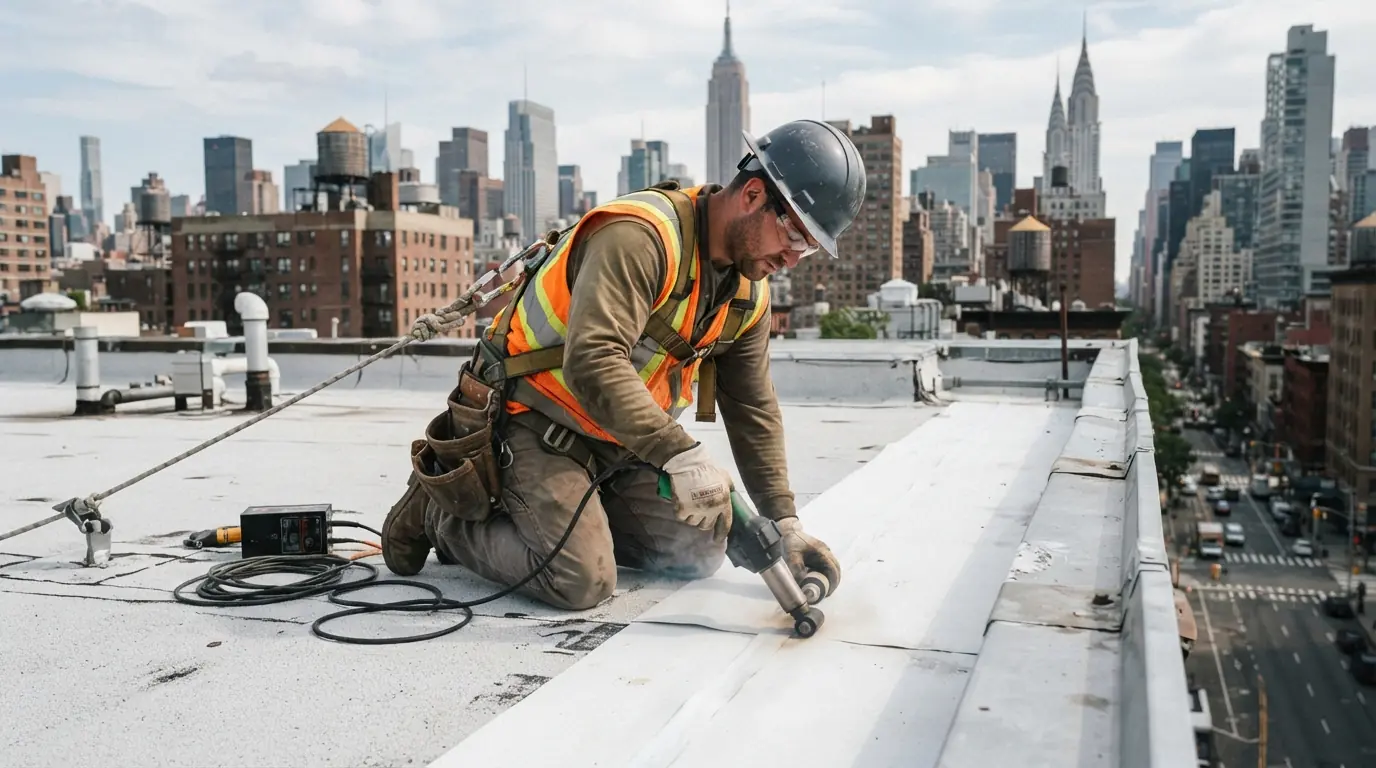
Quick answer: Liquid-applied roof waterproofing is a resin, often PMMA or polyurethane, applied in coats with a reinforcing fleece to form one continuous membrane. In New York, NY it is used where roofs are crowded with dunnage, pipes and equipment, on setbacks and terraces, and to flash details sheet membranes handle poorly.
What the job involves
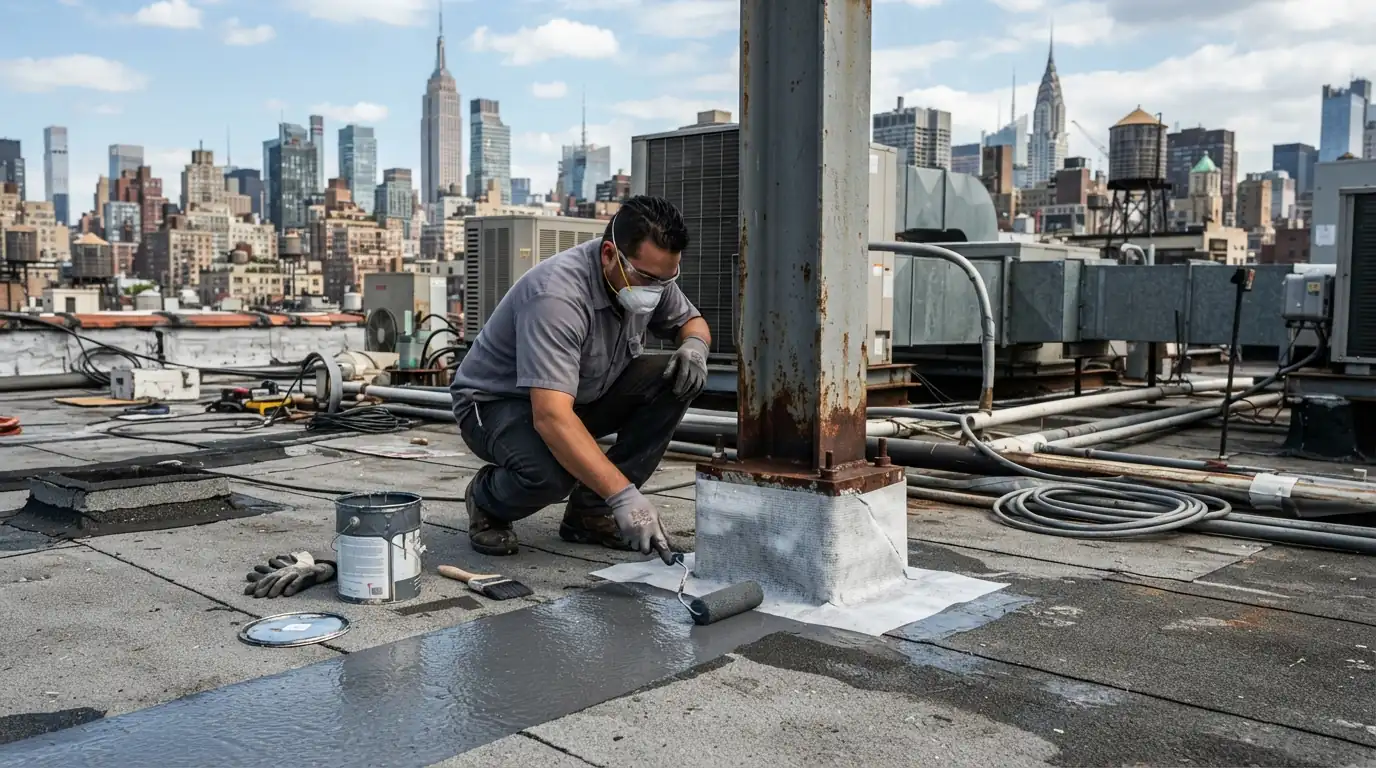
A sheet membrane has to be cut and seamed around every leg of dunnage, every pipe and every railing post. Each cut is a seam, and each seam is a place to leak. A liquid membrane flows around the object and cures into one piece with no seams at all.
The tradeoff is that the result depends heavily on surface preparation, weather and film thickness. The substrate has to be clean, dry and primed, and each coat has to go on at the thickness the maker specifies, with the fleece fully embedded.
Your options
| Factor | Liquid-applied | Sheet membrane |
|---|---|---|
| Seams | None. Cures as one piece. | Lapped, taped or welded seams. |
| Crowded roofs | Flows around legs and pipes. | Many cut pieces and flashings. |
| Weather | Needs suitable conditions while curing. | Less sensitive, depending on the system. |
| Large open roofs | Usually costs more per square foot. | Usually the more economical choice. |
Cost factors
PMMA, polyurethane and other resins differ in price and cure time.
Every leg, pipe and curb adds labor.
Cleaning, repairs and primer are a large share of the work.
Thicker systems use more material.
Small setback roofs carry high access costs per square foot.
Some systems need dry, mild days to cure properly.
Variations of the job
Steel dunnage, condensers, exhaust fans and conduit leave little open roof. A liquid membrane seals around every leg and bracket without a pile of cut-and-seamed pieces.
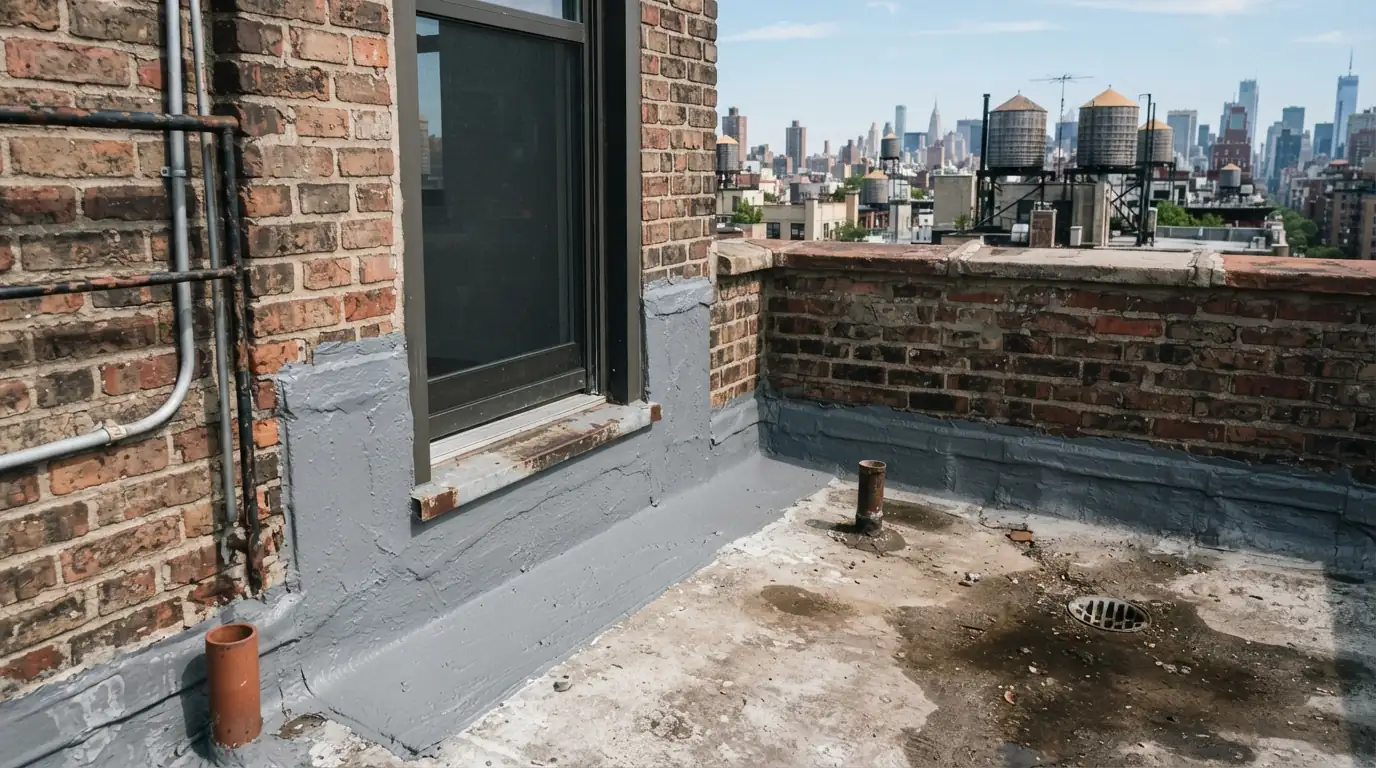
The small roofs at building setbacks sit against walls, windows and doors. Liquid systems turn up walls and under thresholds where sheet goods are hard to finish neatly.
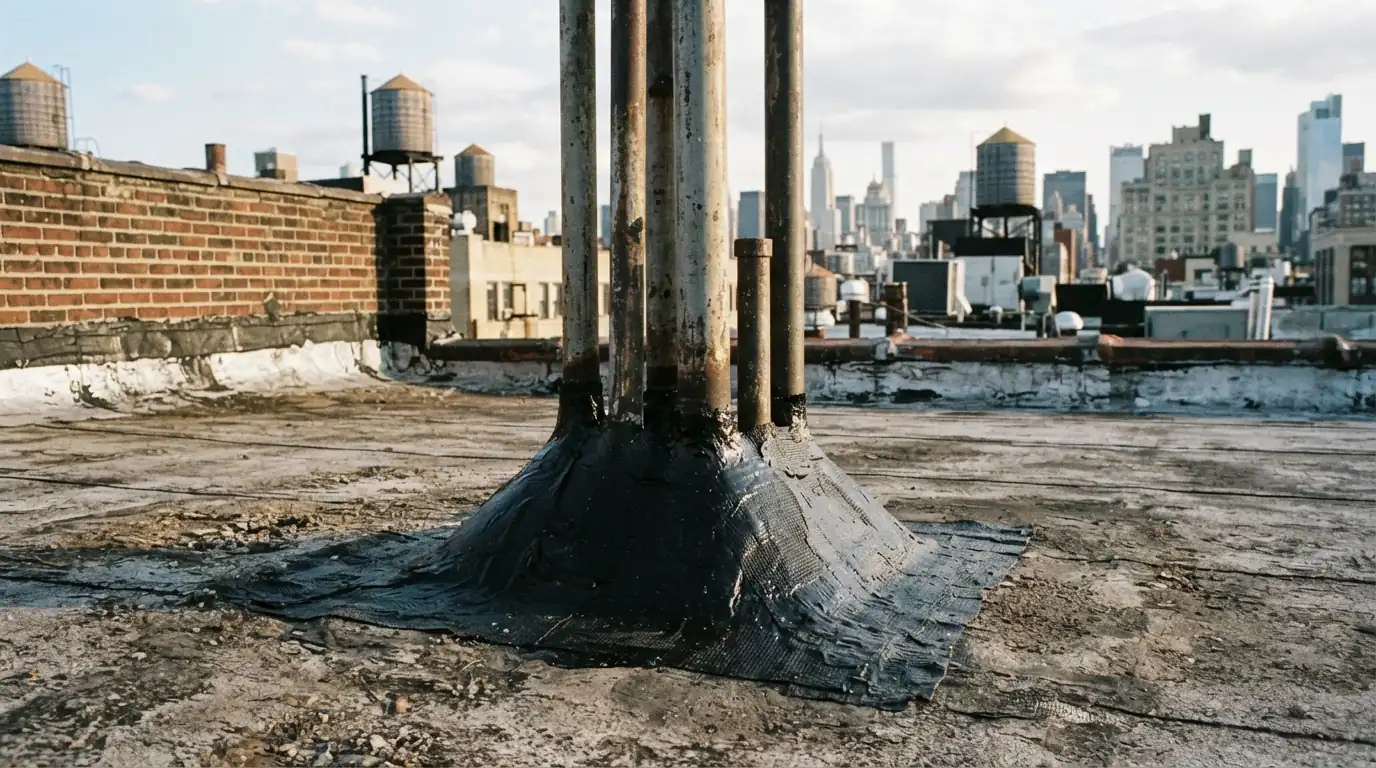
Even on sheet membrane roofs, liquid flashing is often the cleanest way to seal tight pipe clusters, replace old pitch pockets and close odd-shaped penetrations.
Local conditions
In Manhattan, getting material onto a roof is part of the job, with dumpster permits, early-morning sidewalk staging and sometimes a crane for heavy rolls. Liquid systems arrive in pails that can go up a stairwell or freight elevator, and they leave little tear-off debris when applied over a sound substrate. On crowded roofs above narrow streets, that alone can make them the practical choice.
What is included
How it runs
Loose material removed, repairs made, surface cleaned and dried.
Primer matched to the substrate: membrane, concrete, metal or masonry.
Fleece set in resin at every leg, pipe, curb and wall.
Field fleece embedded in the base coat where the system calls for it.
Top coat applied and thickness checked before cure.
Makers of reinforced liquid membranes and liquid flashing systems found on New York roofs.
Questions we hear
No. A coating restores the surface of an existing roof. A reinforced liquid membrane is a waterproofing system in its own right, built thicker with fleece embedded in the resin.
Often, if the existing roof is dry and sound and the system is approved for that surface. Wet or loose areas are removed and repaired first.
It depends on the chemistry. Some PMMA systems cure fast enough to walk on the same day, others need longer, and the schedule follows the system's cure time.
Some systems can be applied in cold weather and some cannot. The maker's temperature and moisture limits set the schedule.
Yes, especially where the membrane has to turn up walls and under doors. Pavers or decking over it need protection so they do not wear the surface.
Related services
Leaks under a terrace are waterproofing leaks. We lift the pavers or decking, rebuild the membrane and drainage beneath, and put the surface back.
Learn moreTray and built-in-place green roofs for owners meeting the sustainable roofing zone requirement, over a membrane built to carry them.
Learn morePolyiso and tapered insulation that meets energy code at re-roof time and gives a flat roof the slope it needs to drain.
Learn moreCall for a roof survey and a liquid-applied waterproofing plan.
New York service office
1256 5th Ave, New York, NY 10029