Leaks & Emergencies
If water is coming in, start here. The job is to stop the water, find the real entry point and only then talk about anything bigger.
Roofing contractor · New York, NY and Long Island
Water through the ceiling, a membrane split at the seams, or a parapet letting rain into the wall? We answer around the clock and work on flat, shingle, slate and metal roofs across the city and Long Island.
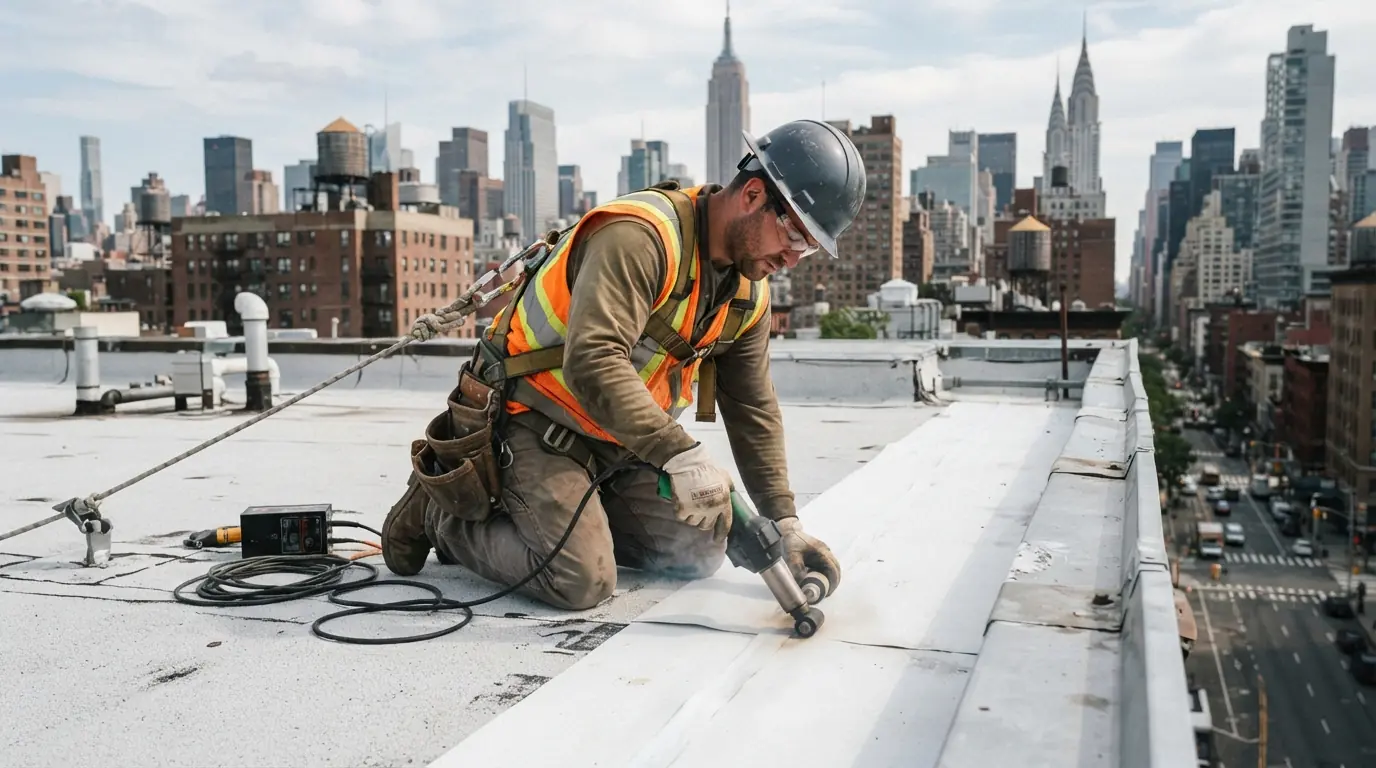
Roofing systems we install and repair, from makers such as GAF, Carlisle SynTec, Johns Manville, Siplast and Velux. On a repair we match the system already on your roof where we can.
Quick answer: Roof leaks in New York, NY usually start at a flashing, a seam or a drain, not in the open field of the roof, so the repair begins at the parapet, the skylight curb or the drain bowl. We find that entry point, make it watertight on the same visit where the roof allows, and tell you plainly whether repair or replacement makes sense.
Services
Every job below has its own page. See all 35 roofing services.
If water is coming in, start here. The job is to stop the water, find the real entry point and only then talk about anything bigger.
Most of the city lives under a flat roof. We repair and install the membrane systems those buildings actually use.
The edges and openings of a roof leak far more often than the middle of it.
Shingle, slate, metal and mansard work, from Long Island colonials to rowhouse roofs the Landmarks Commission has a say over.
Roof water has to go somewhere. We keep the path from the roof edge to the ground working.
For owners, boards and managing agents who want to know the state of a roof before it becomes an emergency.
Warning signs
A ring that grows after each storm means water is getting in somewhere above it.
Ponding wears a membrane out early and hides slow leaks.
Water gets into the top of the wall and runs down inside it.
Seams or trapped moisture are failing at the surface.
Wind got under the tabs, and the underlayment is now doing the roof's job.
Curb flashing or a worn gasket is letting water past.
Local conditions
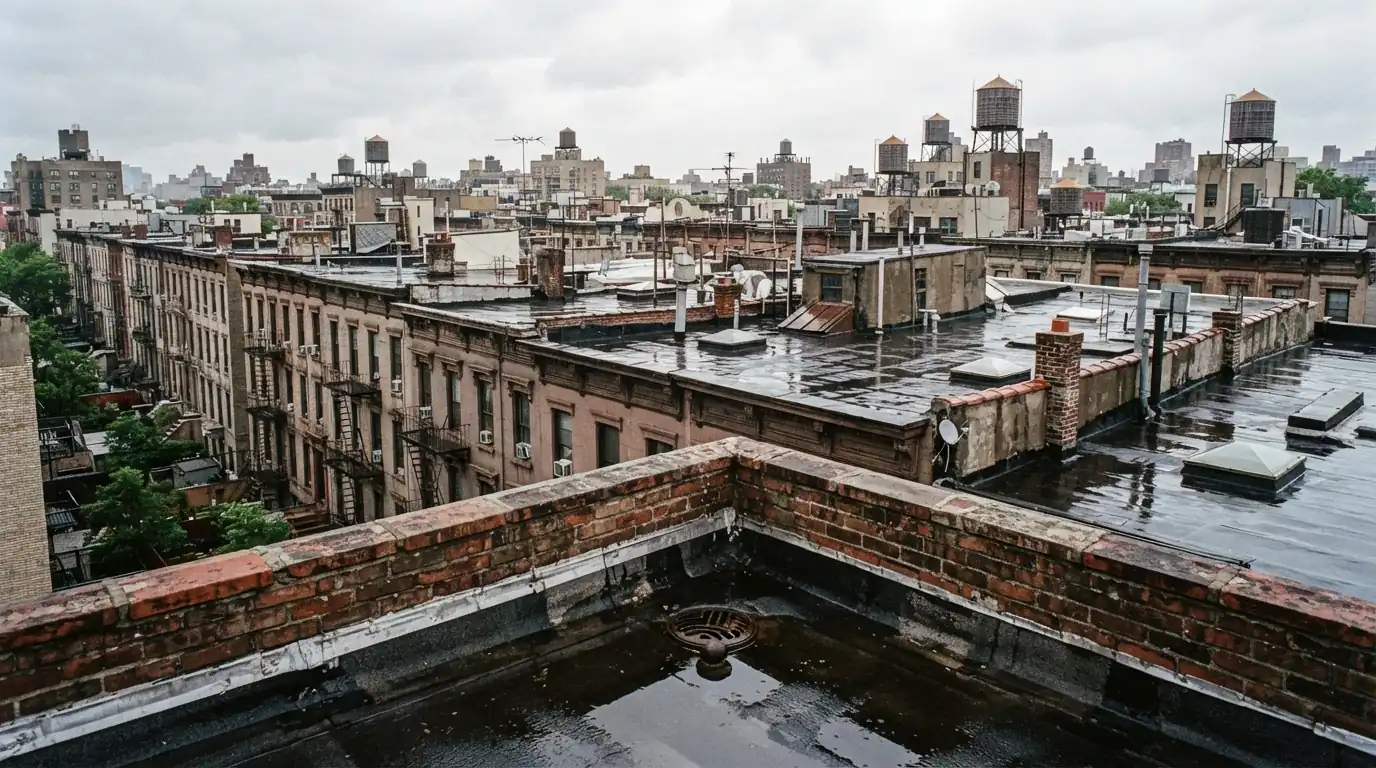
Most residential buildings in the city sit under a flat or nearly flat roof: the brownstones of Harlem and Brooklyn, the attached row houses of Queens, the walk-ups of the Bronx. A flat roof doesn't shed water, it holds it until the drain takes it away, so every seam, every flashing and every inch of parapet gets tested by standing water and by freeze and thaw.
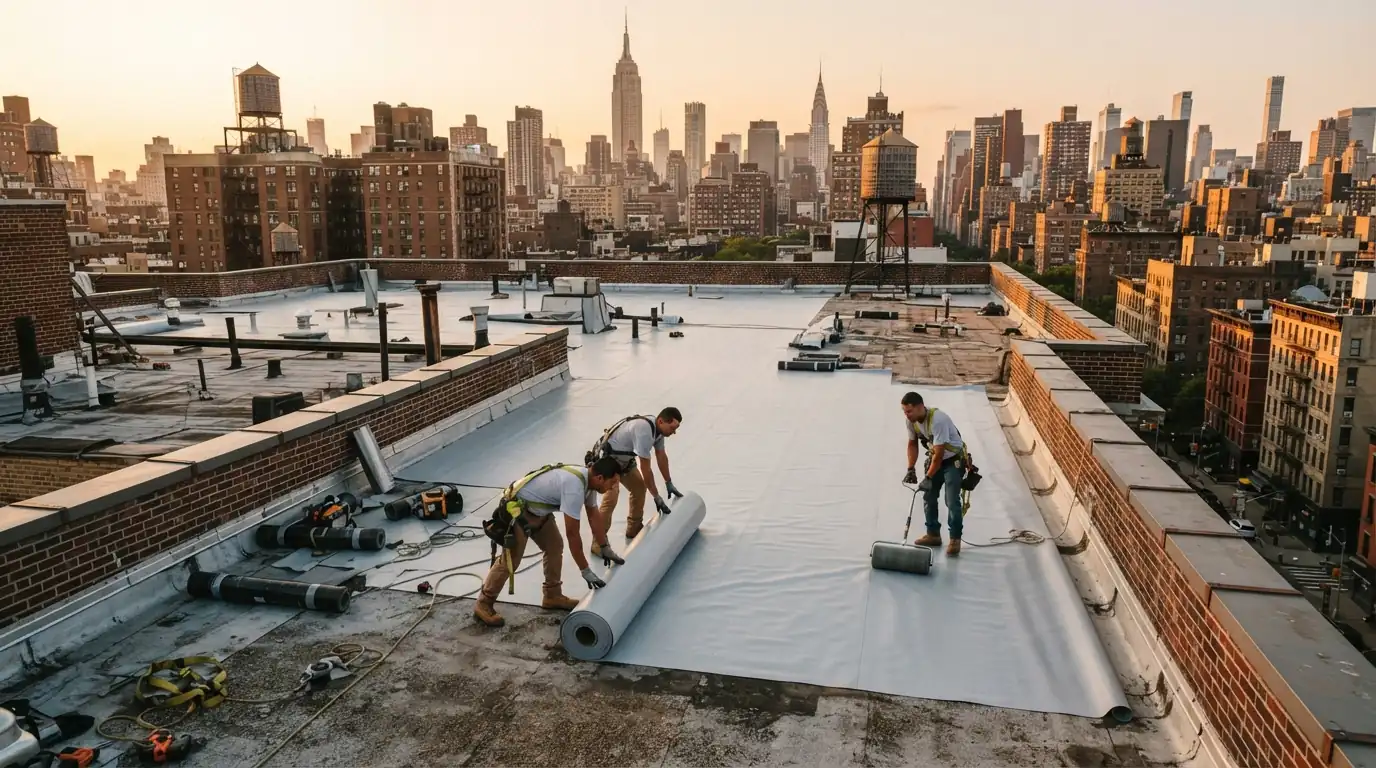
That is why so much of our work happens at the edges. We reflash parapets, rebuild the ones that have started to lean, reset coping, and replace the drains and scuppers that let water pond. When the membrane itself is finished we install EPDM and TPO from makers such as Carlisle SynTec and Johns Manville, and modified bitumen systems from Siplast and Soprema, in the reflective finishes the city's cool roof rules call for.
Manhattan adds its own friction. Debris needs a dumpster permit, material is often staged on the sidewalk early in the morning, and a full replacement raises the sustainable roofing zone question.
From first call to dry ceiling
Tell us where the water shows, what kind of roof it is and how you reach it. An active leak gets treated as one.
Seams, flashings, drains, parapets, skylight curbs. We photograph what we find so you can see it without climbing a ladder.
What stops the leak today, what the lasting repair is, and when replacement is the smarter spend.
Where the job needs a Department of Buildings filing, a Landmarks permit or a board's sign-off, that is sorted before material arrives on your sidewalk.
We protect the building below, do the work, clear the debris and walk the finished roof with you or send the photos if you cannot get up there.
We pick up at any hour. Tell us what you are seeing and we will tell you what happens next.
Call (929) 632-1136Service area
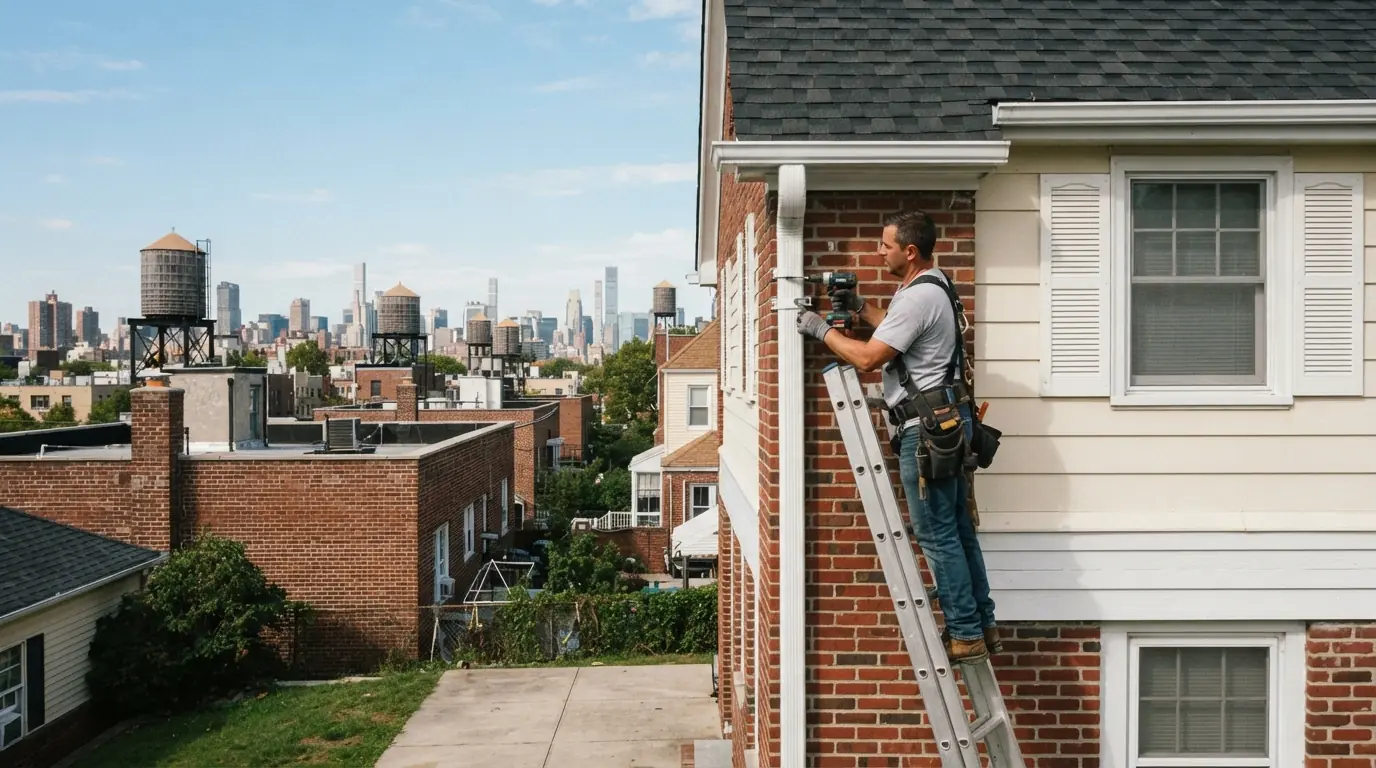
Summit Roofing & Exteriors works from a service office on Fifth Avenue near the north end of Central Park and a head office in Huntington on the North Shore. From the city office our crews reach Manhattan first, then Brooklyn, Queens, the Bronx and Westchester County to the north. The Huntington office looks after Long Island, where the work shifts to shingle roofs, gutters and siding.
Response depends on the hour, the weather and which bridge you are on the far side of, so we give you an honest window on the phone. See exactly where we work.
Borough and county pages: Brooklyn, Queens, The Bronx, Staten Island, Nassau County, Suffolk County and Westchester County.
How we work
A patch over the wet spot lasts until the next hard rain. We trace water back to where it enters, which is usually a flashing, a seam or a drain.
Before-and-after photos of every repair and a plain answer when a repair is only buying time.
Sustainable roof zones, cool roof reflectivity, parapet observations, Landmarks permits. We raise them at the estimate, never halfway through.
The stain on the ceiling is where the water stopped, not where it started. Here is how the path gets traced back to the real entry point.
Learn moreSince November 2019, replacing an entire roof in the city can bring a requirement for solar panels, a green roof, or both. Here is what triggers it and how owners plan for it.
Learn morePublished figures give a starting point. What your roof costs depends on what is under it, what the city requires, and how hard it is to get material up there.
Learn moreQuestions we hear
Yes. In the city most of our work is on flat and low-slope roofs: EPDM rubber, TPO, modified bitumen and coatings, plus the parapets, skylights and drains around them. On Long Island and on rowhouse mansards we repair and replace shingle, slate and metal roofs.
We answer the phone 24 hours a day, seven days a week. While you wait, move what you can out from under the leak, put a bucket down, photograph the ceiling and the water for your insurer, and stay off the roof, especially if it is wet or dark.
Possibly. Since November 15, 2019, Local Laws 92 and 94 require a sustainable roofing zone, meaning solar, a green roof or both, when an existing building replaces its entire roof deck or roof assembly. Areas taken up by mechanical equipment, fire access paths and parapets are excluded. We check which side of the line your project falls on before pricing it.
Since January 1, 2024, every New York City building with a parapet facing a street, sidewalk or other public right-of-way needs that parapet observed once a year, whatever the building's height. Detached one- and two-family homes are exempt. The report is kept on file for six years instead of being filed with the Department of Buildings, and unsafe conditions have to be corrected within 90 days.
Yes, with a Landmarks Preservation Commission permit in hand first. The Commission expects historic roofing materials to be repaired or replaced in kind wherever possible, so slate stays slate and copper stays copper where it can be seen.
Age matters less than what is under the surface. One open seam on a dry roof is a repair. Wet insulation across a wide area, a membrane that has been patched over patches, or a deck that flexes underfoot points to replacement. A repair on a roof like that only buys a season, and we will say so.
Published 2026 figures for New York City residential flat roofs run about $7 to $15 per sq ft installed, and Manhattan logistics such as debris permits and sidewalk staging typically add $1,000 to $5,000. Those are planning ranges from industry cost guides, not a quote. Membrane choice, insulation, access and the condition of the deck move the number.
One number, answered day and night, for New York, NY and Long Island.
New York service office
1256 5th Ave, New York, NY 10029