Stains on the ceiling beside the chimney
The most common sign of failed flashing.
A chimney is a hole in the roof surrounded by brick that moves differently from everything around it. When its flashing, crown or joints fail, water runs down beside the flue and into the rooms below.
Quick answer: Chimney leaks in New York, NY usually come from failed step or counter flashing where brick meets roof, a cracked crown on top of the chimney, or open mortar joints above the roofline. Repair means reflashing the chimney properly, sealing or rebuilding the crown, and repointing the brick above the roof.
What the job involves
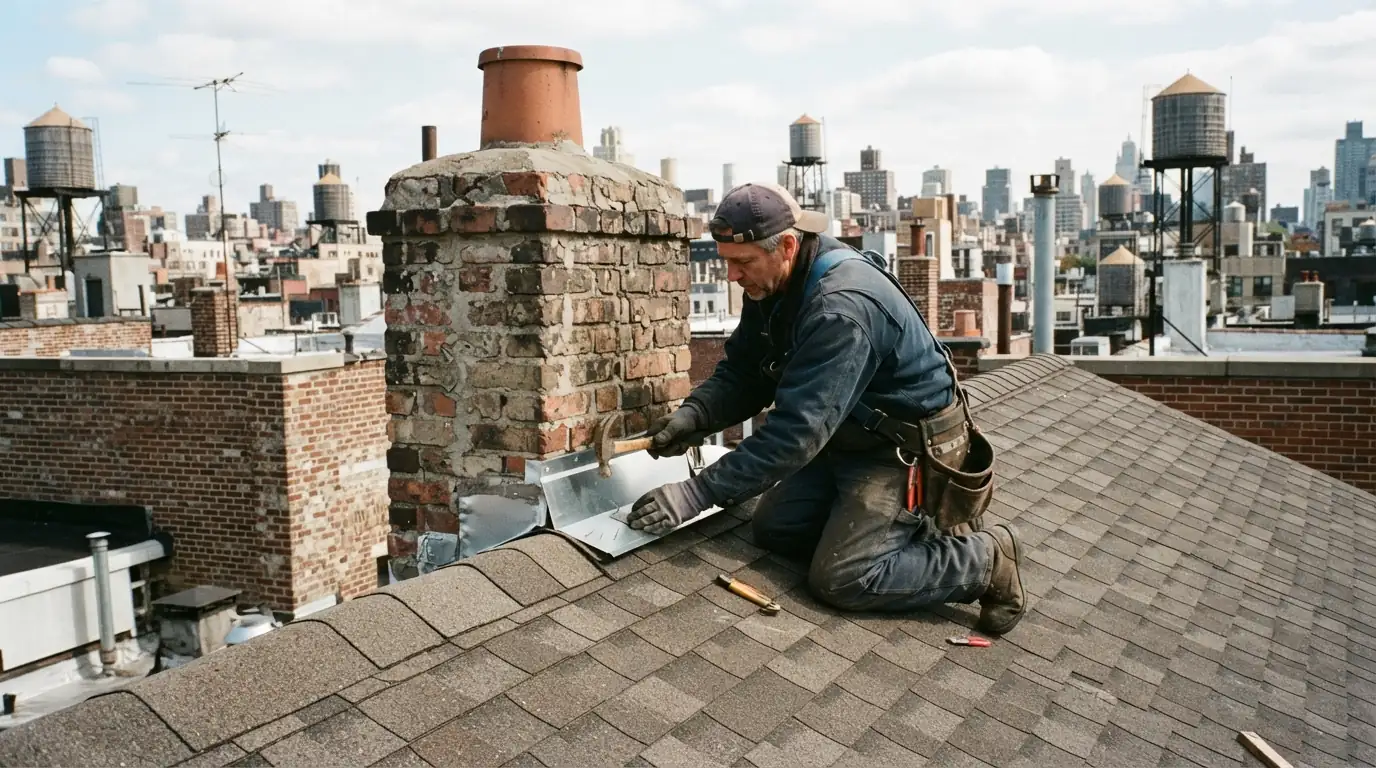
At the roofline, step flashing runs under each course of shingles up the sides of the chimney, and counter flashing set into the mortar joints laps over it. On a flat roof, membrane base flashing wraps the chimney with metal counter flashing above. Either fails when sealant has been used in place of proper metal laps.
Higher up, the crown around the flue cracks and lets water into the chimney's core, and open joints soak water into the brick itself. A leak beside a chimney can come from any of the three, so each is checked before anything is sealed.
Cost factors
Step and counter flashing on shingles, or membrane and counter flashing on a flat roof.
Aluminum, coated steel or copper.
Sealing hairline cracks costs far less than rebuilding the crown.
How many joints and bricks need work above the roof.
Wide chimneys on sloped roofs need a cricket behind them.
Tall chimneys and steep roofs need staging.
Variations of the job
Individual L-shaped pieces woven into each shingle course up the sides of the chimney, so every piece sheds onto the shingle below. Missing or rusted pieces are replaced as a set, not caulked.
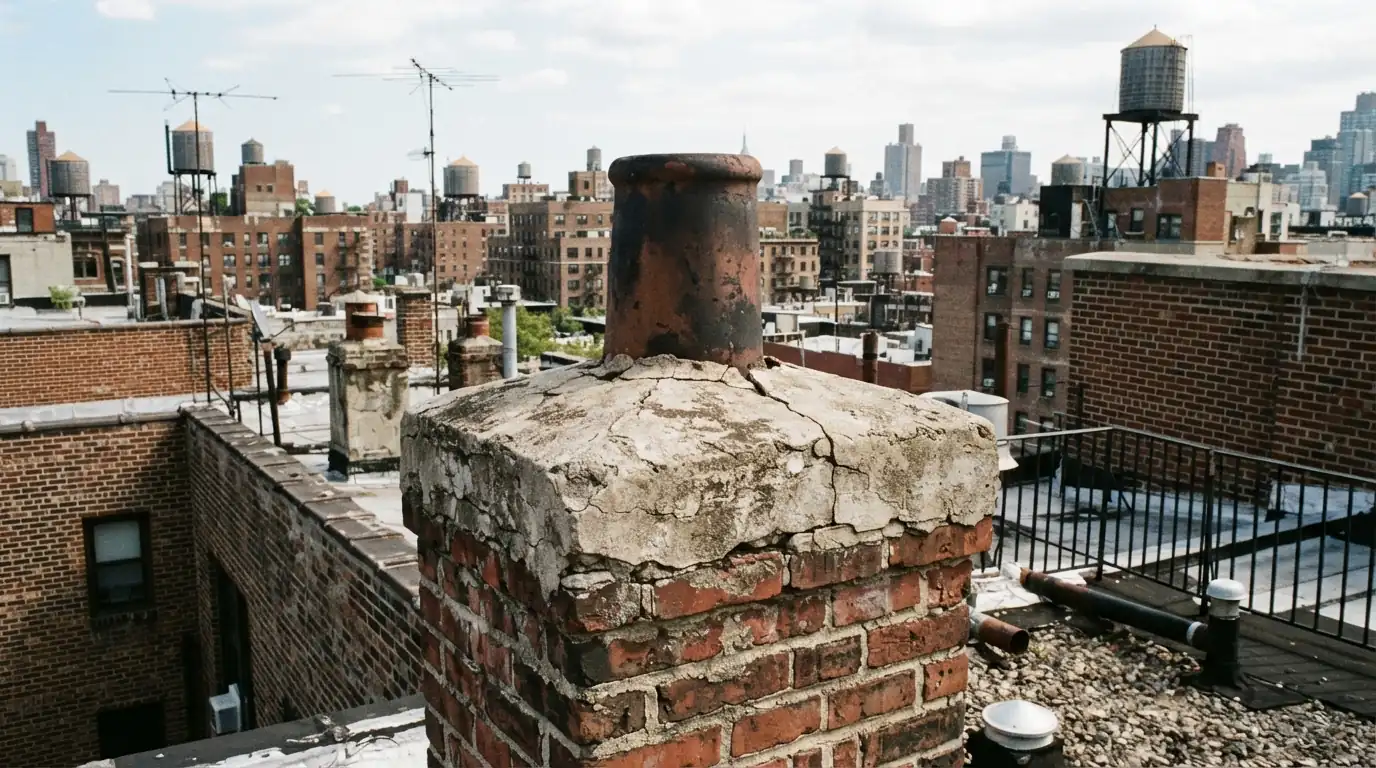
The sloped cap around the flue. Hairline cracks can be sealed with a crown coating; a crown that is breaking up or has no overhang is rebuilt with a drip edge so water falls clear of the brick.
Open joints above the roof let water into the brick and behind the counter flashing. Joints are ground out and repointed with mortar that suits the brick, and counter flashing is reset into fresh joints.
Do it yourself or call
Local conditions
Asphalt shingles are by far the most common residential roof covering in New York State, and on Long Island that usually means a chimney rising through a shingle roof. That is the detail where step flashing matters most: every shingle course along the chimney needs its own piece, and shingles replaced without reweaving that flashing leave a leak waiting for the next wind-driven rain.
How it runs
Flashing, crown and joints checked, with photos.
Water run at the flashing, then the brick, to find the path.
Repoint and rebuild the crown before new flashing.
Step and counter flashing, or membrane and counter flashing.
Water test the finished detail and send photos.
Warning signs
The most common sign of failed flashing.
Water moving down inside the masonry.
Water getting into the chimney's core.
Flashing near the end of its life.
A past repair that is likely failing.
Salts left as water works through the masonry.
Questions we hear
Wind-driven rain reaches the flashing and brick on one side of the chimney. Leaks that follow a particular wind direction usually point to flashing or open joints on that face.
No. Sealant dries out and cracks, and it often hides failed metal underneath. The proper repair replaces the step and counter flashing.
The sloped cap on top of the chimney around the flue. It sheds water off the top, and when it cracks, water gets into the chimney's core.
Wide chimneys on sloped roofs usually do. A cricket is a small ridge behind the chimney that splits water around it instead of letting it pool against the brick.
Not necessarily. Most leaks are at the flashing or crown. The flue liner is a separate check for a chimney professional, especially if the chimney vents a heating appliance.
Related services
Stair and elevator bulkheads have their own roofs, walls and door sills, and each one leaks. We roof, flash and seal them as a unit.
Learn moreLeaking curbs, cracked domes and rusted roof hatches repaired or replaced, with the curb flashed into the roof properly.
Learn moreOpen joints, bulging brick and failed inside-face flashing are where many top-floor leaks begin. We repoint, rebuild and reflash.
Learn moreCall and we will check the flashing, the crown and the brick.
New York service office
1256 5th Ave, New York, NY 10029