Brown rings on the ceiling
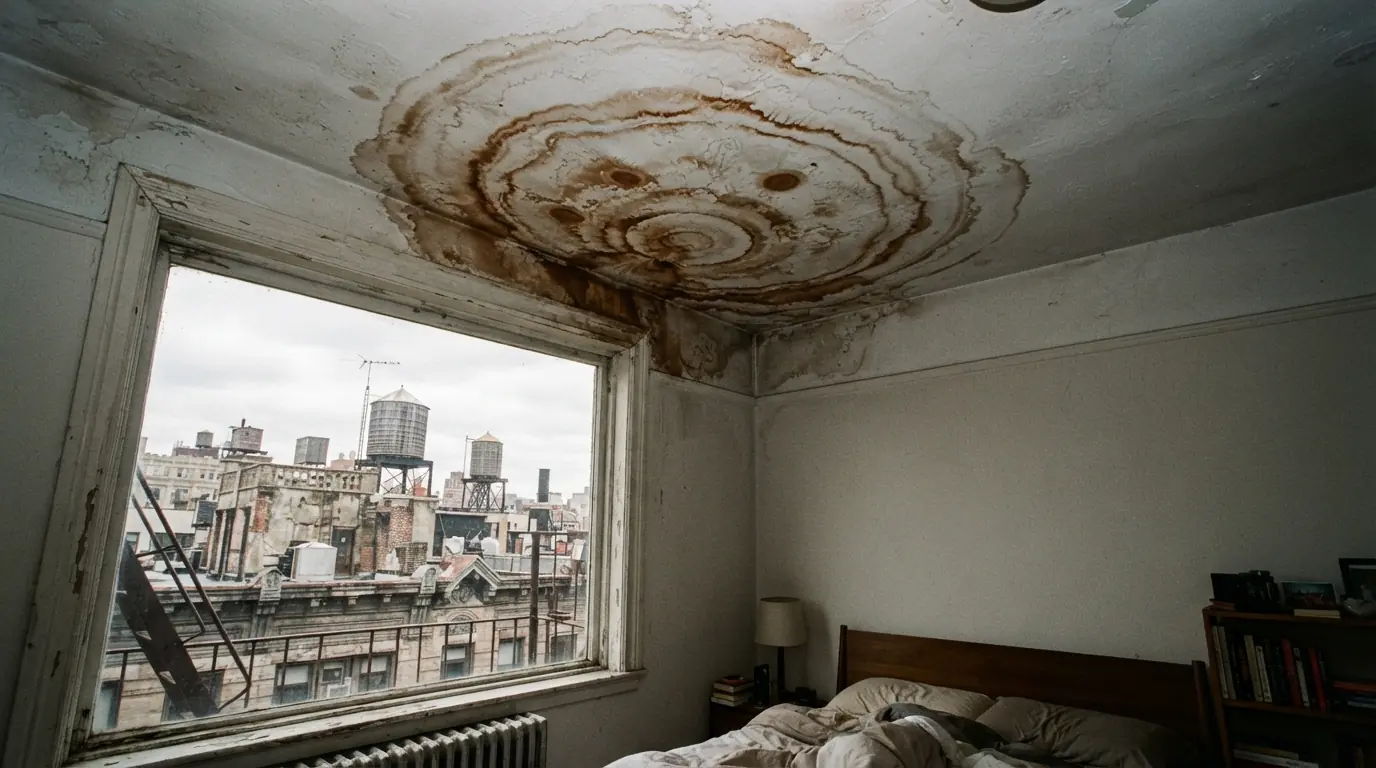
Each ring is a separate wetting. Rings that keep growing mean an active leak.
The stain on your ceiling is where the water ended up, not where it got in. We trace it back across the roof and repair the point of entry.

Quick answer: Most roof leaks in New York, NY enter at a flashing, an open seam, a parapet or a drain, and the water often travels several feet before it shows on a ceiling. A lasting repair starts by finding that entry point, then repairing it with material that matches the existing roof.
What the job involves
On a flat roof, water that gets through the membrane runs along the insulation or deck until it finds a gap in the ceiling below. On a pitched roof it follows rafters and the underside of the sheathing. A stain in a back bedroom can come from a flashing near the front parapet.
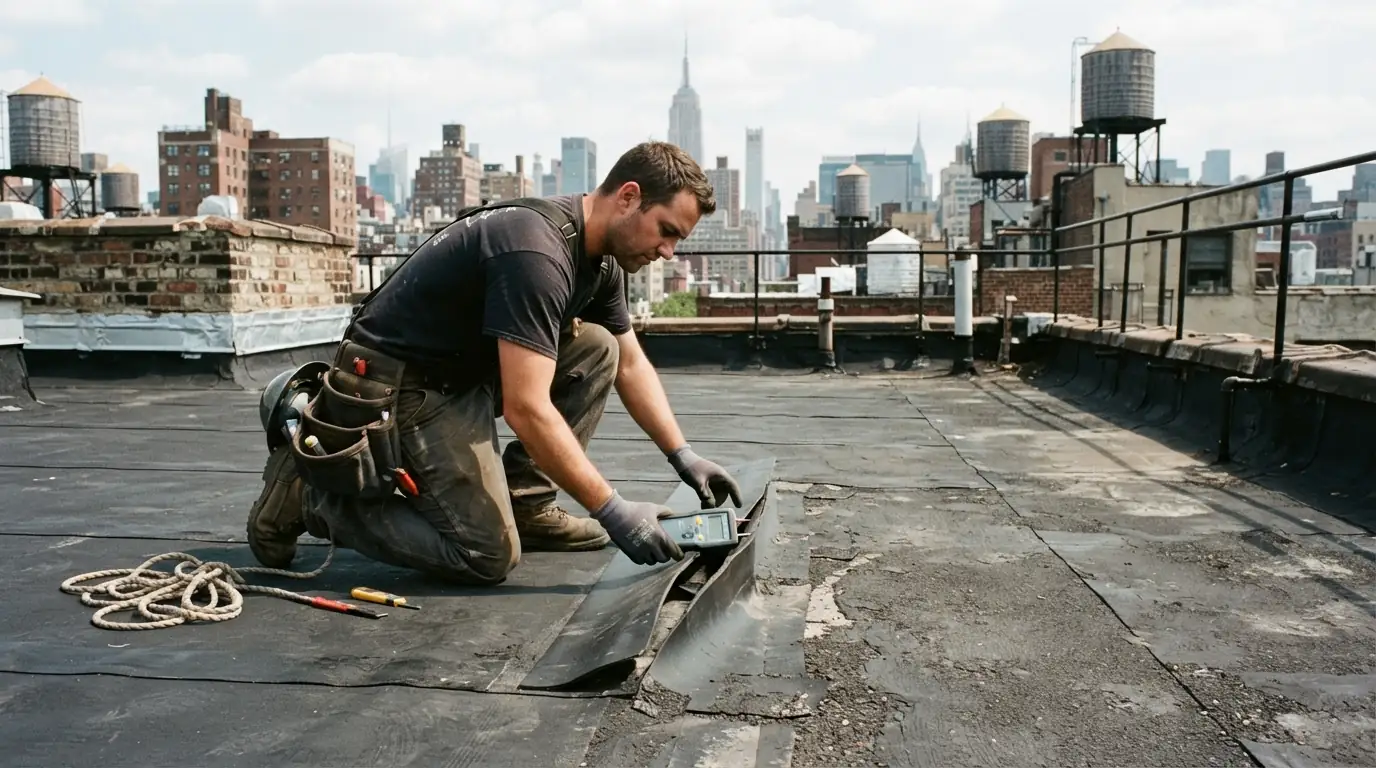
So the repair starts on the roof, not at the ceiling. We check every seam, flashing, drain and penetration between the stain and the high side of the roof, and when the source is not obvious we water test one section at a time until the leak shows itself.
How it runs
We note where the water shows inside and match it to the roof above.
Seams, flashings, drains and penetrations between the stain and the high side.
Water testing one area at a time when the source is not visible.
With materials compatible with the existing roof, not a smear of roof cement.
Water test the repaired area where the roof allows, and send you photos.
Warning signs
Each ring is a separate wetting. Rings that keep growing mean an active leak.
Often water coming through a parapet or coping, not the roof surface.
Slow leaks show up as smell and mildew before they show as drips.
Wet insulation under the membrane gives when you step on it.
Trapped moisture or loose adhesion, both early warnings.
Water is getting past the curb flashing.
Variations of the job
A stain that grows after each storm but dries between them points to an opening that only takes water in a real downpour: an open lap, a cracked boot, or a slow drain that lets water rise above the flashing.
Older EPDM seams were glued, and the adhesive lets go at the edges. We clean, prime and re-lap them with seam tape and a cover strip, or heat-weld open TPO seams back together.
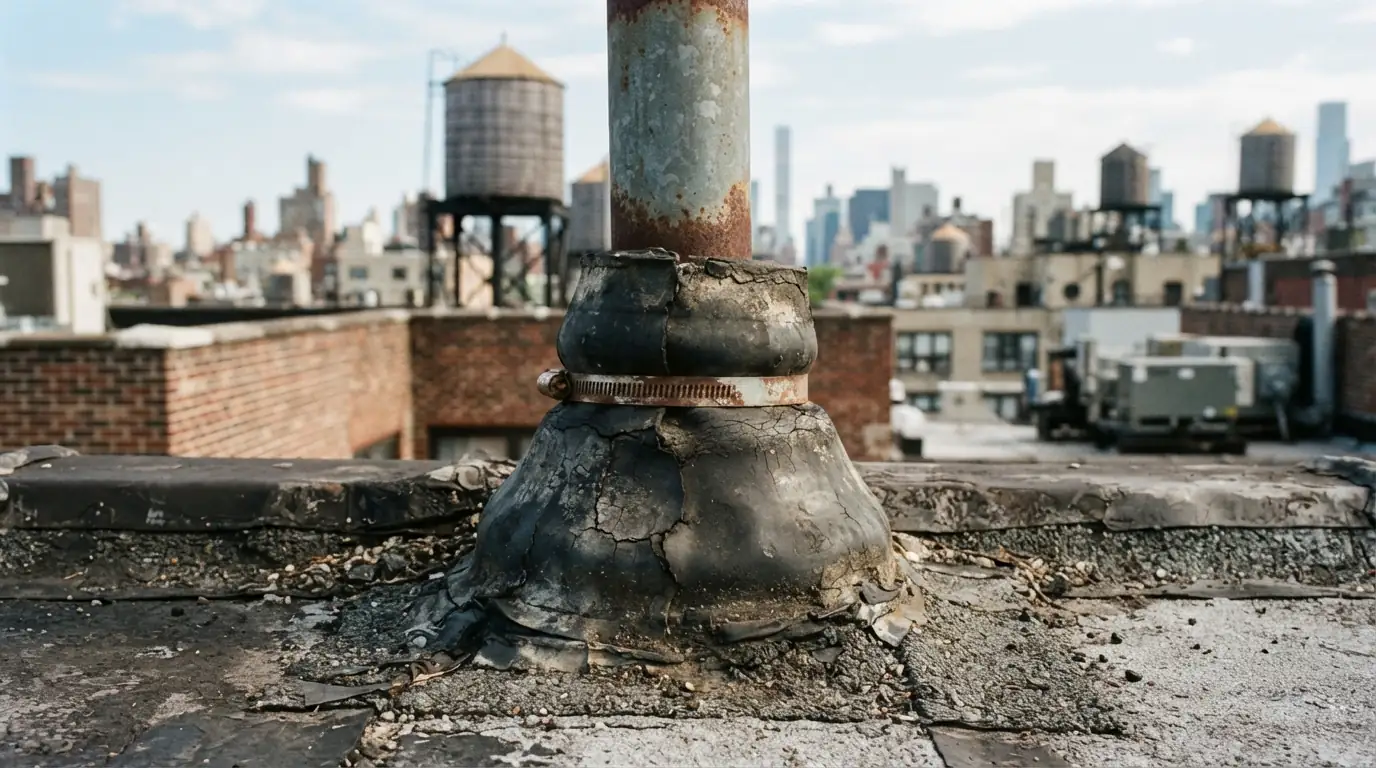
Rubber pipe boots crack in the sun and pitch pockets dry out and shrink. We replace boots, rebuild pitch pockets and flash new pipe sleeves into the membrane.
Wind-driven rain gets in sideways, under coping stones, through open joints in a parapet, past a loose counter flashing. These leaks often come from the wall, so we check the masonry too.
Local conditions
Much of the city lives under flat roofs, from the brownstones of Harlem to the attached row houses of Queens. On a flat roof a leak rarely drips straight down. Water that gets under the membrane spreads across the deck or insulation until it finds a gap in the ceiling, so a stain in the middle of a Queens row house can start at a flashing along the party wall. We trace it back before anything gets patched.
Cost factors
An obvious split seam is quick. A leak that needs section-by-section water testing takes hours first.
EPDM, TPO, modified bitumen, shingle and slate each need their own materials and methods.
Soaked insulation near the entry point is cut out and replaced, or it returns as a soft spot.
Rebuilding a flashing at a wall or curb takes longer than patching open roof.
Hatches, bulkheads, ladders and height change how long it takes to get people and material up.
If water is coming through a parapet or coping, part of the fix is masonry.

Call any time. We find where the water gets in and repair that, not the stain.
Call (929) 632-1136Your options
| Option | When it fits | What to know |
|---|---|---|
| Repair | One or a few entry points on a roof that is otherwise dry and sound. | The right call most of the time, and the least disruptive. |
| Recover | A single existing roof layer that is dry, over a sound deck. | Codes do not allow recovering a roof that is water-soaked or already has two or more layers. |
| Replace | Wet insulation across a wide area, patches on patches, or leaks in many places. | A tear-off to the deck, which in New York City can bring the sustainable roofing zone rules into play. |
Questions we hear
Direction and intensity matter. Wind-driven rain reaches openings on one side of the building, and very heavy rain can pond above flashing height when drains cannot keep up.
No. Sealing the ceiling or the underside of the deck traps water in the roof and hides the problem. The repair has to happen where the water gets in.
Rarely. Asphalt roof cement is not compatible with EPDM rubber and bonds poorly to TPO, and on other roofs it dries out and cracks. Repairs should use material that matches the roof.
We water test the repaired area where the roof allows it and tell you what to watch for after the next heavy rain.
Then the fix may be at the parapet, coping or counter flashing rather than the roof surface. We check the masonry above the roofline as part of tracing the leak.
Yes. On pitched roofs most leaks come from valleys, flashings at walls and chimneys, and missing or cracked pieces, repaired with matching material where it is still made.
Related services
For the leak three roofers have already patched. Moisture surveys, core cuts and water tests show where the roof is wet and why.
Learn moreWater still sitting two days after rain wears a membrane out early. We correct the slope with tapered insulation, added drains or deck repair.
Learn moreA clogged or cracked drain bowl turns a sound roof into a pond. We clear, rebuild and replace interior drains, scuppers and overflows.
Learn moreCall any time and we will trace the leak to where it starts.
New York service office
1256 5th Ave, New York, NY 10029